Table of Contents
- Introduction
- 3D Printing Technologies in Dentistry
- Materials for Dental 3D Printing
- Clinical Applications
- Benefits for Dental Laboratories
- Challenges and Limitations
- Future Trends
- Conclusion
Introduction
Additive manufacturing, commonly known as 3D printing, has emerged as one of the most transformative technologies in modern dental laboratory operations. Unlike subtractive manufacturing (CNC milling), which removes material from a block to create a restoration, 3D printing builds objects layer by layer from a digital file. This fundamental difference opens up new possibilities in design freedom, material efficiency, and production scalability.
From surgical guides and working models to permanent restorations and removable denture bases, 3D printing is reshaping how dental laboratories operate, compete, and deliver value to their dentist clients.
3D Printing Technologies in Dentistry
Stereolithography (SLA)
SLA uses an ultraviolet laser to cure liquid photopolymer resin layer by layer. It offers the highest resolution and surface finish among dental 3D printing technologies, making it ideal for producing highly detailed working models, surgical guides, and provisional restorations. Typical layer thicknesses range from 25 to 100 micrometers.
Digital Light Processing (DLP)
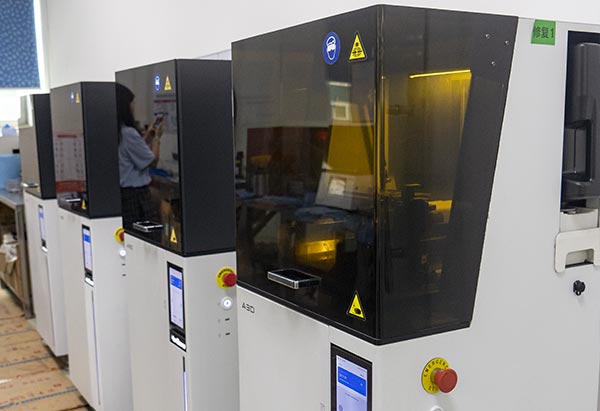
DLP works similarly to SLA but uses a digital projector screen to cure an entire layer of resin simultaneously, rather than tracing it with a laser point. This makes DLP significantly faster than SLA while maintaining excellent accuracy. DLP has become the preferred technology for high-volume dental labs due to its speed-to-quality ratio.
Selective Laser Sintering/Melting (SLS/SLM)
These technologies use lasers to fuse metal powder particles, enabling the production of cobalt-chromium and titanium frameworks for bridges, implant bars, and partial denture frameworks. SLM produces dense, mechanically strong metal structures that rival cast frameworks in quality.
PolyJet/MultiJet Printing
These inkjet-based systems deposit droplets of photopolymer and cure them with UV light. They can print multiple materials simultaneously, enabling multi-color and multi-hardness objects—useful for educational models and diagnostic setups.
Materials for Dental 3D Printing
The range of printable dental materials has expanded rapidly, enabling an increasing variety of clinical applications:
| Material Type | Applications | Key Properties |
|---|---|---|
| Photopolymer resins (model) | Working models, dies, study models | High detail, smooth surface, rapid curing |
| Surgical guide resins | Implant surgical guides | Biocompatible, autoclavable, rigid |
| Provisional resins | Temporary crowns, bridges | Esthetic, durable for 6+ months, polishable |
| Denture base resins | Complete/partial denture bases | Biocompatible, impact-resistant, bondable to teeth |
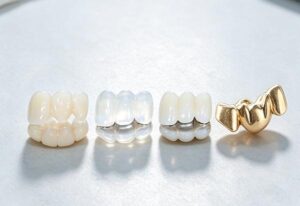
| Permanent crown/bridge resins | Long-term restorations (emerging) | High filler content, wear-resistant, esthetic |
| Metal powders (CoCr, Ti) | Frameworks, implant abutments, bars | High strength, biocompatible, precise fit |
Clinical Applications
1. Diagnostic and Working Models
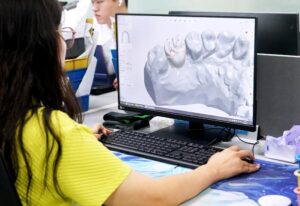
3D-printed models from intraoral scan data have largely replaced stone models in digital workflows. They offer consistent accuracy, immediate availability, and eliminate the need for physical storage space. Printed die models with removable dies streamline the fabrication process for crown and bridge work.
2. Surgical Guides
Implant surgical guides printed from CBCT-planned data ensure precise osteotomy placement according to the prosthetic plan. Printed guides are available within hours of planning, compared to days for milled guides, and offer comparable accuracy.
3. Provisional Restorations
3D-printed provisional crowns and bridges provide an efficient alternative to hand-fabricated or milled temporaries. They offer consistent quality, excellent aesthetics, and can be produced in batches for full-mouth rehabilitation cases.
4. Denture Fabrication
Printing denture bases has revolutionized removable prosthodontics. A digital denture workflow involves designing the denture base in CAD software, printing it, and then bonding prefabricated denture teeth. This approach reduces fabrication time by 50–70% compared to conventional methods while improving consistency.
5. Metal Frameworks
SLM-printed cobalt-chromium frameworks for implant bars, bridge substructures, and partial denture frameworks offer precise fit and excellent mechanical properties. The digital workflow eliminates casting variables and enables complex internal geometries impossible with traditional methods.
Benefits for Dental Laboratories
- Material efficiency: Additive processes waste minimal material compared to subtractive milling, reducing costs for expensive materials
- Mass customization: Each printed object can be unique with no additional setup cost, enabling personalized prosthetics at scale
- Reduced labor: Automated overnight printing reduces technician hands-on time and increases throughput
- Consistent quality: Digital production eliminates human variability in waxing, casting, and packing
- Design freedom: Complex internal structures, undercuts, and anatomical details are possible without tooling constraints
- Faster turnaround: Same-day production of models, guides, and provisionals improves service to dentist clients
Challenges and Limitations
- Material limitations: Printable materials, while expanding, still cannot match the full range of mechanical and aesthetic properties of milled ceramics or cast metals
- Post-processing requirements: Printed objects require washing, post-curing, and support removal, adding production steps
- Equipment investment: Professional-grade printers cost $5,000–$100,000+, requiring ROI analysis
- Regulatory compliance: Permanent restorations require FDA/CE-approved materials and validated workflows
- Build size constraints: Most dental printers have limited build platforms, requiring multiple prints for large cases
- Aging and stability: Some photopolymer resins continue to polymerize over time, potentially causing dimensional changes
Future Trends
The trajectory of dental 3D printing points toward several key developments:
- Direct printing of final restorations: New high-ceramic-content resins are approaching the mechanical properties needed for permanent posterior restorations
- Full-color printing: Multi-material, multi-color printers will enable direct printing of aesthetic restorations without staining
- AI-assisted design: Automated design algorithms will further reduce design time and standardize quality
- Continuous printing technologies: CLIP (Continuous Liquid Interface Production) and similar technologies promise dramatically faster build speeds
- Bio-printing: Experimental research into printing scaffolds for periodontal regeneration and pulp tissue engineering
Conclusion
3D printing has evolved from a novelty to an essential technology in modern dental laboratories. Its ability to produce accurate, customized prosthetic components efficiently has transformed workflows, reduced costs, and expanded clinical possibilities. While challenges remain—particularly in material development for permanent restorations—the rapid pace of innovation suggests that additive manufacturing will play an increasingly central role in dental prosthetics.
For dental laboratories, investing in 3D printing capability is no longer a question of if, but when and how comprehensively. Labs that embrace this technology gain a significant competitive advantage in accuracy, efficiency, and service quality—positioning themselves as forward-thinking partners in the digital dental ecosystem.