Table of Contents
- Introduction
- The Multiple Functions of Provisionals
- Materials for Temporary Restorations
- Fabrication Techniques
- Aesthetic Provisionals for Smile Design
- Implant Provisionals and Soft Tissue Conditioning
- Digital Approaches to Provisionals
- Conclusion
Introduction
Temporary restorations—often called provisionals or temporaries—are frequently viewed as mere placeholders between the preparation appointment and final restoration delivery. This perspective significantly underestimates their clinical importance. In reality, provisional restorations serve multiple critical functions that directly influence the success of the definitive restoration and the overall treatment outcome.
A well-designed provisional is not just a temporary fix; it is a diagnostic tool, a biological protector, an aesthetic preview, and a communication device between dentist, patient, and laboratory. Understanding and leveraging these functions transforms provisionals from an afterthought into a strategic component of comprehensive dental care.
The Multiple Functions of Provisionals
1. Biological Protection
After tooth preparation, the dentin is exposed to oral fluids, bacteria, and thermal stimuli. A properly sealed provisional restoration protects the pulp from irritation, prevents bacterial microleakage, and maintains periodontal health by ensuring proper marginal adaptation and embrasure form.
2. Functional Maintenance
Provisionals must maintain occlusal contacts and proximal relationships during the interim period. This prevents tooth migration, supra-eruption of opposing teeth, and changes in the inter-arch relationship that could compromise the fit of the final restoration.
3. Diagnostic Value
For complex cases involving changes to vertical dimension, occlusal scheme, or anterior guidance, provisionals serve as a functional diagnostic test. The patient lives with the provisional design for weeks or months, allowing the clinician to evaluate comfort, phonetics, aesthetics, and function before committing to the final design.
4. Aesthetic Preview
In aesthetic dentistry, provisionals allow patients to experience their new smile before the final restorations are fabricated. This is particularly valuable for full-mouth rehabilitations and smile makeovers, where patient input on tooth size, shape, and color is essential for satisfaction.
5. Soft Tissue Management
Provisionals shape and condition the gingival tissue around preparations and implants. Proper contour and emergence profile guide tissue healing, establish the gingival architecture, and create the sulcular form that the final restoration will maintain.
6. Laboratory Communication
An approved provisional serves as a three-dimensional prescription for the dental laboratory. The ceramist can replicate the provisional’s contour, length, surface texture, and color characteristics in the final restoration, ensuring the result matches what the patient has approved.
Materials for Temporary Restorations
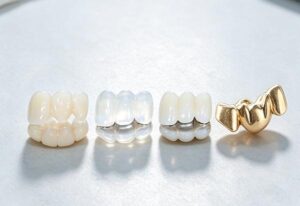
Polymethyl Methacrylate (PMMA)
PMMA has been the traditional material for provisional restorations for decades. It offers excellent aesthetics, good wear resistance, and the ability to be relined and repaired. However, it has an exothermic setting reaction that can damage pulp tissue, and the free monomer can irritate soft tissues. PMMA is available in autopolymerizing and heat-polymerizing formulations.
Bis-Acryl Composite Resin
Bis-acryl is the most commonly used material for direct provisional fabrication today. It offers minimal shrinkage, low exotherm, good color stability, and excellent handling characteristics. It comes in multiple shades and can be polished to a smooth surface. However, it is more brittle than PMMA and harder to repair.
3D-Printed Resins
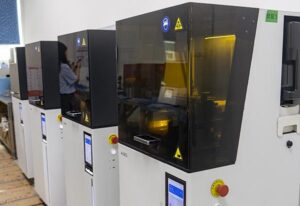
The newest category of provisional materials, 3D-printed resins, offer consistent quality, excellent marginal fit, and the ability to fabricate complex designs directly from digital files. These materials provide good aesthetics and are available in formulations certified for use up to 12 months or longer. They are particularly valuable for full-arch provisionals and implant cases where multiple units are needed.
Milled PMMA
CAD/CAM milled PMMA blocks produce provisionals with superior mechanical properties compared to directly fabricated ones. The industrial polymerization process results in higher density, better color stability, and reduced polymerization shrinkage. Milled provisionals are ideal for long-term interim restorations in complex cases.
Fabrication Techniques
Direct Technique
The provisional is fabricated directly in the patient’s mouth using a matrix (vacuum-formed shell, silicone index, or preformed crown form) loaded with provisional material. This method is fast and efficient for single units or short-span bridges but offers less control over aesthetics and internal fit.
Indirect Technique
An impression is taken after preparation, and the provisional is fabricated on a stone model in the laboratory. This allows better control of contour, aesthetics, and occlusion but requires an additional appointment or same-day lab service.
CAD/CAM Technique
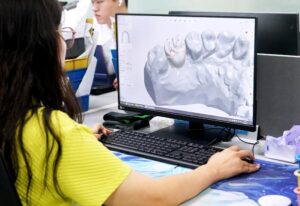
The provisional is designed digitally and milled or 3D-printed. This approach offers the highest consistency and quality, particularly for multiple-unit cases. Digital provisionals can be designed before the preparation appointment from a pre-operative scan, enabling a truly guided workflow.
Aesthetic Provisionals for Smile Design
In comprehensive aesthetic treatment, provisionals become the blueprint for the final result. The process typically follows these steps:
- Digital smile design: The desired outcome is planned using facial analysis and digital design tools
- Mock-up fabrication: A 3D-printed or milled mock-up is tried in the patient’s mouth for evaluation
- Guided preparation: Tooth reduction is guided by the mock-up, ensuring conservative and precise preparation
- Provisional fabrication: Provisionals are made from the approved design, maintaining the planned contours and aesthetics
- Evaluation period: The patient wears the provisionals for 2–4 weeks, providing feedback on aesthetics, phonetics, and function
- Refinement: Adjustments are made to the provisionals based on patient feedback and clinical evaluation
- Final impression: The approved provisional is used as the blueprint for the final restoration design
Implant Provisionals and Soft Tissue Conditioning
Provisionals play a uniquely important role in implant dentistry. Unlike natural teeth, implants lack the periodontal ligament that shapes and supports the gingival tissue. The provisional restoration must actively sculpt the peri-implant soft tissue to create a natural emergence profile.
This is achieved through:
- Progressive subgingival contouring: Gradually increasing the emergence profile to shape the tissue
- Customized abutment design: Creating a concave or convex subgingival form that supports the tissue architecture
- Extended wear periods: Implant provisionals may remain in place for 3–6 months to fully condition the tissue before final restoration
- Tissue copy technique: Impressioning the conditioned tissue contour for replication in the final abutment and restoration
Digital Approaches to Provisionals
Digital technology has revolutionized provisional fabrication:
- Pre-operative design: Provisionals are designed before preparation from existing scans, enabling guided reduction
- Same-day fabrication: Milled or printed provisionals are ready immediately after preparation
- Easy reproduction: If a provisional is lost or damaged, the digital file allows instant replacement
- Seamless lab communication: Digital files of approved provisionals are sent to the lab as a design reference
- Cross-arch coordination: Upper and lower provisionals can be designed simultaneously for optimal occlusion
Conclusion
Temporary restorations are far more than interim placeholders—they are essential clinical tools that protect biology, maintain function, preview aesthetics, condition soft tissue, and communicate design intent to the laboratory. Investing time and attention in provisional design and fabrication pays dividends in the quality, predictability, and longevity of the final restoration.
As digital workflows continue to streamline provisional fabrication, the barrier to producing high-quality, diagnostically valuable provisionals decreases. Practices that embrace this approach—treating provisionals as integral components of treatment rather than temporary afterthoughts—consistently achieve superior clinical and aesthetic outcomes.