Table of Contents
- Introduction
- The All-on-4 Protocol
- The All-on-6 Protocol
- Detailed Comparison
- Surgical Considerations
- Prosthetic Options and Materials
- Case Selection Guidelines
- Conclusion
Introduction
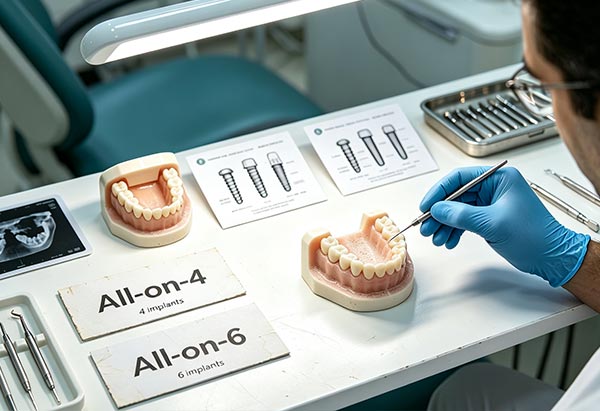
For patients facing complete edentulism or terminal dentition, full-arch dental implant rehabilitation offers a life-changing solution that restores function, aesthetics, and confidence. Two treatment protocols have emerged as the predominant approaches for full-arch fixed restoration: All-on-4 and All-on-6. Each protocol has distinct advantages, indications, and clinical considerations that influence treatment planning.
Understanding the differences between these protocols is essential for clinicians, laboratories, and patients to make informed decisions that optimize outcomes while managing constraints of anatomy, budget, and clinical complexity.
The All-on-4 Protocol
The All-on-4 concept, pioneered by Dr. Paulo Maló in the 1990s, uses four implants per arch to support a fixed full-arch prosthesis. The defining feature of this protocol is the placement of the two posterior implants at an angled trajectory—typically 30–45 degrees from the occlusal plane—to maximize bone contact in the anterior region where bone quality is typically superior.
Key Features
- Four implants: Two anterior axial implants and two posterior tilted implants
- Angled posterior implants: Engage more cortical bone and reduce the cantilever length
- Immediate loading: A fixed provisional prosthesis can often be placed the same day
- Bone graft avoidance: The tilted posterior implants often eliminate the need for sinus augmentation
- Prosthetic design: Typically uses a titanium or zirconia framework with acrylic or composite denture teeth
Advantages
- Lower cost (fewer implants and components)
- Shorter surgical time
- Often avoids bone grafting procedures
- Well-documented clinical outcomes (95%+ survival at 10 years)
- Immediate function possible in suitable cases
Limitations
- Each implant bears more load—implant failure has greater consequences
- Limited prosthetic flexibility if biomechanics are unfavorable
- Angled abutments require specialized components
- May not be suitable for patients with severe parafunctional habits
The All-on-6 Protocol
The All-on-6 approach uses six implants per arch, providing additional support points and distributing occlusal forces across a wider area. The additional implants reduce the load per implant and can improve the biomechanical profile of the restoration, particularly for patients with favorable bone availability.
Key Features
- Six implants: Typically placed in a more distributed pattern across the arch
- Reduced load per implant: Better force distribution
- Shorter cantilevers: Additional posterior support reduces prosthetic extension
- Greater prosthetic options: Can accommodate individual crowns or segmented bridges in some cases
- Requires adequate bone: Sufficient posterior bone volume needed for additional implants
Advantages
- Superior biomechanical force distribution
- Reduced cantilever lengths decrease prosthetic fracture risk
- Greater redundancy—if one implant fails, the prosthesis may still be supported
- Better support for harder prosthetic materials (e.g., full zirconia bridges)
- Enhanced long-term maintainability
Limitations
- Higher cost (more implants, abutments, and surgical time)
- Requires sufficient bone volume for six implants
- Longer surgical procedure
- May require bone grafting if posterior bone is deficient
Detailed Comparison
| Factor | All-on-4 | All-on-6 |
|---|---|---|
| Number of implants | 4 per arch | 6 per arch |
| Implant positioning | 2 axial + 2 tilted | Variable, more distributed |
| Bone graft requirement | Often avoided | More likely needed |
| Cost (implants + surgery) | Lower | ~30–50% higher |
| Load per implant | Higher | Lower |
| Cantilever length | Longer | Shorter |
| Prosthetic fracture risk | Higher (longer span) | Lower (shorter span) |
| Survival rate (10 yr) | 94–97% | 95–98% |
| Redundancy if implant fails | Low risk—may need replacement | Higher—prosthesis may survive |
Surgical Considerations
Bone Volume and Quality
The primary determinant between All-on-4 and All-on-6 is posterior bone availability. The All-on-4 protocol was specifically designed to address the common scenario of posterior bone atrophy in the maxilla (sinus pneumatization) and mandible (nerve proximity). By angling the posterior implants, the protocol utilizes available anterior bone effectively.
All-on-6 is preferred when posterior bone is sufficient (either naturally or after grafting) and when the additional biomechanical support is warranted by patient factors such as heavy occlusion, bruxism, or high aesthetic expectations.
Immediate Loading Criteria
Both protocols can support immediate loading (same-day provisional prosthesis) when specific criteria are met:
- Primary implant stability (ISQ ≥ 60)
- Adequate bone density and volume
- Controlled occlusion with protected articulation
- Patient compliance with soft diet and care instructions
Prosthetic Options and Materials
Provisional Prostheses
Immediate provisional prostheses are typically fabricated from acrylic resin on a titanium bar or milled PMMA. These provisionals serve both functional and aesthetic purposes during the healing phase, allowing tissue conditioning and patient adaptation.
Definitive Prostheses
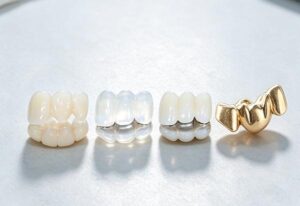
- Titanium framework + acrylic teeth: The traditional approach—strong, repairable, and cost-effective. The titanium bar provides rigidity while acrylic teeth offer aesthetics and easy replacement.
- Zirconia framework + ceramic layering: Premium aesthetic option. Monolithic or layered zirconia provides superior aesthetics and stain resistance but is more expensive and harder to repair.
- Monolithic zirconia bridge: Full-contour zirconia milled in one piece. Maximum strength and aesthetics but requires excellent fit and careful occlusal management.
- Hybrid metal-resin: Combines a cast or milled metal framework with composite resin veneering. A middle-ground option balancing strength, aesthetics, and cost.
Screw-Retained vs Cement-Retained
Full-arch restorations are almost universally screw-retained to facilitate retrievability for maintenance and hygiene. Screw retention eliminates cement excess issues and allows the prosthesis to be removed for cleaning, component replacement, or repair.
Case Selection Guidelines
Choose All-on-4 When:
- Posterior bone is insufficient for additional implants
- Patient has budget constraints
- Immediate function is desired without grafting
- Bone quality in the anterior region is favorable
- Patient has moderate parafunctional habits
Choose All-on-6 When:
- Adequate posterior bone is available
- Patient has heavy bruxism or high bite forces
- Premium prosthetic materials (full zirconia) are planned
- Patient desires maximum long-term redundancy
- Budget allows for additional implants
Conclusion
Both All-on-4 and All-on-6 protocols offer reliable, evidence-based solutions for full-arch implant rehabilitation. The choice between them should be driven by anatomical factors, biomechanical considerations, patient preferences, and budget—rather than a one-size-fits-all approach.
All-on-4 remains the more accessible and widely applicable protocol, particularly for patients with posterior bone deficiency. All-on-6 provides superior biomechanics and redundancy for cases where anatomy and budget permit. In both cases, the quality of the prosthetic restoration—its fit, material, occlusion, and aesthetics—plays an equally important role in long-term success.
As digital planning and guided surgery continue to improve the precision of implant placement, and as new prosthetic materials expand the options for definitive restorations, both protocols will continue to deliver excellent outcomes for the growing population of patients seeking full-arch dental rehabilitation.