Table of Contents
- Introduction
- The Evolution of Dental CAD/CAM
- Core Components of a Dental CAD/CAM System
- Materials in CAD/CAM Production
- Benefits for Dental Laboratories
- Challenges and Considerations
- The Future of CAD/CAM in Dentistry
- Conclusion
Introduction
Computer-Aided Design and Computer-Aided Manufacturing (CAD/CAM) technology has fundamentally transformed dental laboratory operations over the past three decades. What began as an experimental concept in the 1980s has evolved into the backbone of modern dental fabrication—enabling laboratories to produce restorations with unprecedented precision, efficiency, and consistency.
Today, CAD/CAM technology touches virtually every aspect of dental laboratory production, from single-unit crowns to full-arch implant prostheses. Understanding the capabilities, limitations, and trajectory of this technology is essential for any laboratory seeking to remain competitive in an increasingly digital industry.
The Evolution of Dental CAD/CAM
The Pioneering Era (1980s–1990s)
The concept of digital dental fabrication was first demonstrated by Dr. François Duret in the 1970s, but it was the CEREC system, introduced by Siemens (later Sirona) in 1985, that brought CAD/CAM into clinical reality. The original CEREC system used a chairside scanner and a compact milling unit to produce inlays and onlays in a single appointment. While revolutionary, early systems were limited by slow processing, limited material options, and marginal fit that did not yet match conventional techniques.
The Laboratory Adoption Era (2000s)
The 2000s saw the emergence of laboratory-focused CAD/CAM systems. Companies like 3Shape, Dental Wings, and Amann Girrbach introduced scanners and design software specifically for dental laboratories. The introduction of zirconia as a machinable ceramic created new demand for CAD/CAM milling capabilities, as zirconia could not be effectively processed by conventional dental laboratory techniques.
Key developments during this period included:
- Desktop model scanners that digitized stone casts
- Specialized dental CAD software with libraries for crown, bridge, and framework design
- Dry and wet milling systems optimized for dental materials
- Pre-sintered zirconia blocks that could be milled efficiently and then sintered to full density
The Digital Integration Era (2010s–Present)
The current era is characterized by seamless digital integration across the entire workflow:
- Intraoral scanners eliminate the need for physical impressions and model scanning
- Cloud-based platforms connect clinics and laboratories for instant file transfer and case management
- AI-assisted design tools automate routine design decisions while maintaining clinician control
- 5-axis milling systems produce complex geometries with exceptional precision
- 3D printing complements milling for specific applications like models, guides, and dentures
- Integrated quality control through digital measurement and verification
Core Components of a Dental CAD/CAM System
1. Data Acquisition (Scanning)
The CAD/CAM workflow begins with digital data acquisition. This can be achieved through:
- Intraoral scanners: Capture patient anatomy directly (iTero, 3Shape TRIOS, CEREC Primescan, Medit)
- Desktop model scanners: Digitize conventional stone models or impressions
- CBCT integration: Incorporate 3D radiographic data for implant planning and surgical guide fabrication
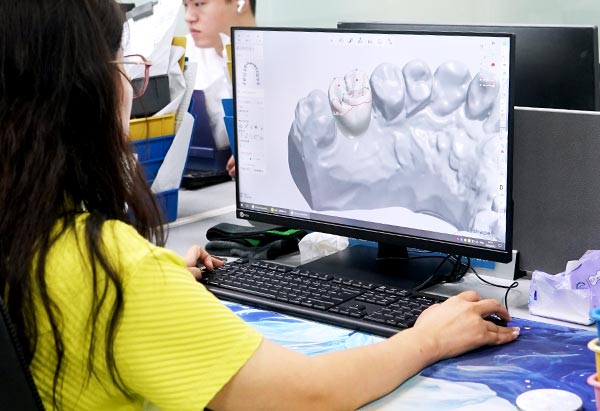
2. Design (CAD Software)
Modern dental CAD software provides design tools for virtually every restoration type:
- Single crowns, inlays, onlays, and veneers
- Multi-unit bridges and frameworks
- Implant abutments and screw-retained restorations
- Removable partial denture frameworks
- Complete dentures and digital denture bases
- Orthodontic appliances and clear aligners
- Surgical implant guides
Leading CAD platforms include 3Shape Dental System, exocad DentalCAD, Dental Wings DWOS, and CEREC Software. These systems offer varying levels of automation, from fully manual design to AI-assisted auto-design with manual refinement.
3. Manufacturing (CAM and Production)
The CAM component translates digital designs into physical restorations through:
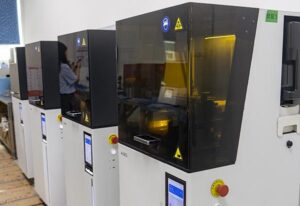
- Subtractive manufacturing (milling): CNC milling machines remove material from blocks to create the restoration. 4-axis and 5-axis systems are standard for dental applications.
- Additive manufacturing (3D printing): Building objects layer by layer for models, guides, dentures, and increasingly for definitive restorations.
- Hybrid approaches: Combining printing for frameworks with milling for surfaces, or printing provisionals and milling finals.
4. Post-Processing and Finishing
After production, restorations require post-processing:
- Sintering for zirconia (reaching 1400–1500°C for several hours)
- Crystallization for lithium disilicate
- Staining and glazing for aesthetic characterization
- Polishing for optimal surface finish
- Quality verification through digital measurement
Materials in CAD/CAM Production
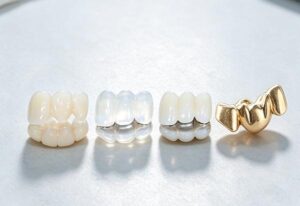
| Material | Production Method | Applications |
|---|---|---|
| Zirconia (Y-TZP) | Milling (pre-sintered or fully sintered) | Crowns, bridges, implant abutments, frameworks |
| Lithium disilicate | Milling (then crystallization) | Anterior crowns, veneers, short bridges |
| Composite ceramic | Milling | Provisionals, long-term temporaries |
| PMMA | Milling or printing | Provisionals, denture bases, models |
| Wax | Milling or printing | Patterns for casting, try-in setups |
| Cobalt-chromium | Milling or SLM printing | Frameworks, implant bars, partial dentures |
| Titanium | Milling or SLM printing | Implant abutments, bars, frameworks |
Benefits for Dental Laboratories
- Consistent quality: Digital production eliminates human variability, ensuring every restoration meets the same standard
- Scalability: A single technician can manage multiple CAM units simultaneously, dramatically increasing output
- Material efficiency: Precise milling paths minimize waste of expensive materials
- Design flexibility: Digital design allows easy modification, comparison, and optimization before production
- Faster turnaround: Same-day production is possible for many restoration types
- Digital records: Every case is stored digitally, enabling easy reproduction and quality tracking
- Reduced physical space: Digital files replace stone model storage, reducing facility space requirements
- Enhanced communication: Digital case management platforms improve communication with dentist clients
Challenges and Considerations
- Capital investment: A complete CAD/CAM system can cost $50,000–$250,000+
- Training requirements: Staff must develop digital design skills, which differ from traditional lab techniques
- Technology obsolescence: Rapid technological advancement means equipment may need upgrading every 5–7 years
- Software licensing: Annual software licenses and updates represent ongoing costs
- Material limitations: Not all dental materials can be effectively processed by CAD/CAM
- Aesthetic control: Some ceramists feel that digital production limits the artistic control needed for the highest aesthetic results
The Future of CAD/CAM in Dentistry
Artificial Intelligence Integration
AI is increasingly embedded in CAD/CAM systems, offering automated margin detection, intelligent tooth morphology suggestions, and predictive occlusal adjustment. Future systems may achieve near-complete autonomous design with clinician approval, further reducing production time.
Advanced Materials
Research is ongoing into new machinable materials, including nano-ceramics with improved mechanical and aesthetic properties, and multi-gradient materials that combine strength and translucency in a single block.
In-Office Production
As equipment becomes more compact and affordable, more dental practices are investing in chairside CAD/CAM systems. This trend may shift some production from laboratories to practices, but also creates opportunities for labs to provide design services and material supply.
Digital Ecosystem Integration
The future points toward fully integrated digital ecosystems where patient data, imaging, treatment planning, design, and production are connected through cloud platforms. This will enable seamless collaboration between all members of the dental team—dentist, specialist, laboratory, and patient.
Sustainability
Digital workflows reduce material waste, eliminate chemical processing, and reduce shipping needs. As sustainability becomes a priority in healthcare, the environmental benefits of CAD/CAM will become an increasingly important advantage.
Conclusion
CAD/CAM technology has evolved from an experimental concept to an indispensable tool in modern dental laboratories. Its impact on quality, efficiency, and capabilities has been transformative, enabling labs to produce restorations that would have been impossible or impractical just a decade ago.
For dental laboratories, the question is no longer whether to adopt CAD/CAM technology, but how to optimize its implementation and stay current with rapid advancements. Labs that invest strategically in CAD/CAM capabilities—balancing equipment, training, and workflow integration—will be best positioned to thrive in the increasingly digital future of dental prosthetics.
As the technology continues to evolve toward AI-driven design, advanced materials, and integrated digital ecosystems, the potential for innovation in dental restoration remains vast. The laboratories that embrace this trajectory will continue to lead the industry in quality, service, and clinical outcomes.