Table of Contents
- Introduction
- Bridge Types by Design
- Bridge Materials
- Material Selection by Clinical Scenario
- Fabrication Workflows
- Longevity and Maintenance
- Conclusion
Introduction
Dental bridges remain one of the most reliable and widely used fixed prosthetic solutions for replacing missing teeth. Despite the growth of dental implants, bridges continue to play an essential role in restorative dentistry—particularly for patients who are not implant candidates, prefer a non-surgical solution, or seek a more affordable alternative.
Selecting the right bridge type and material requires careful consideration of the edentulous span, abutment tooth condition, occlusal forces, aesthetic requirements, and patient preferences. This guide provides a comprehensive overview of bridge designs and materials to support clinical decision-making.
Bridge Types by Design
1. Traditional Fixed Bridge
The conventional fixed bridge consists of pontics (artificial teeth) suspended between two or more retainer crowns (abutments) that are cemented to prepared natural teeth. This is the most common bridge design and is suitable for spans of 1–3 missing teeth with healthy abutment teeth on both sides.
Indications: Single or multiple tooth gaps with sound abutment teeth, adequate bone support, and favorable crown-to-root ratio.
2. Cantilever Bridge
A cantilever bridge is supported by only one abutment tooth, creating a lever arm. The pontic extends from the single retainer. This design is biomechanically less favorable than a traditional bridge and is generally limited to specific clinical situations.
Indications: Anterior tooth replacement where aesthetics are important and occlusal forces are low. Most commonly used for replacing a single lateral incisor using the canine as the abutment.
Limitations: Not recommended for posterior regions due to high occlusal forces that create unfavorable leverage on the abutment tooth.
3. Maryland (Resin-Bonded) Bridge
The Maryland bridge uses metal or zirconia wings that are bonded to the lingual surface of adjacent teeth, rather than full coverage crowns. This conservative approach preserves tooth structure while providing a fixed replacement for missing teeth.
Indications: Single anterior tooth replacement in young patients, congenitally missing laterals, and cases where minimal tooth preparation is desired.
Limitations: Lower retention than conventional bridges, risk of debonding, and potential for metal show-through on thin lingual surfaces. Zirconia-winged Maryland bridges have improved aesthetics but require specialized bonding protocols.
4. Implant-Supported Bridge
When natural teeth are not available or suitable as abutments, an implant-supported bridge uses dental implants as the supporting structures. This design preserves adjacent natural teeth and provides independent support for the pontic(s).
Indications: Multi-tooth gaps where adjacent teeth are unrestored or compromised, patients preferring not to prepare healthy teeth, and cases where implants provide better biomechanical support.
5. Hybrid Bridge Designs
Some clinical situations benefit from hybrid approaches, such as a tooth-implant-supported bridge. These should be approached with caution due to differential mobility between natural teeth (with periodontal ligament) and implants (rigidly osseointegrated), which can create biomechanical complications.
Bridge Materials
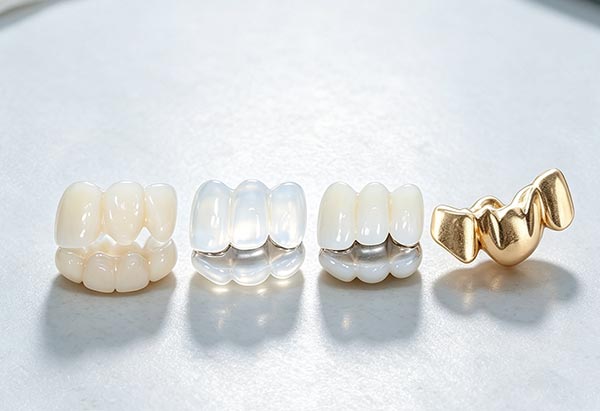
Porcelain-Fused-to-Metal (PFM)
PFM bridges have been the standard for decades, offering reliable strength through the metal substructure and acceptable aesthetics through the ceramic veneer. Noble metal alloys provide superior fit and biocompatibility, while base metal alloys (CoCr, NiCr) offer higher rigidity at lower cost.
Best for: Long-span bridges, posterior bridges, and cases with moderate aesthetic demands.
Monolithic Zirconia
Zirconia bridges offer exceptional strength (800–1200 MPa) without the risk of porcelain chipping. High-translucency zirconia formulations provide increasingly acceptable aesthetics for anterior applications. Zirconia bridges can be milled in one piece for spans up to 4–5 units.
Best for: Posterior bridges, bruxism patients, long-span restorations, and metal-free cases.
Lithium Disilicate
Lithium disilicate bridges provide excellent aesthetics with adequate strength for short-span anterior applications. Flexural strength of 360–500 MPa limits their use to 3-unit anterior bridges.
Best for: Anterior 3-unit bridges with high aesthetic demands and low occlusal forces.
Full Metal (Gold Alloy)
Cast gold alloy bridges offer unmatched longevity, marginal fit, and functional performance. While aesthetically limited to posterior regions, they remain the most durable bridge material available.
Best for: Posterior bridges in patients prioritizing longevity over aesthetics.
Zirconia-Faced (Layered Zirconia)
A zirconia framework with layered porcelain veneer combines the strength of zirconia with enhanced aesthetics. However, porcelain chipping remains a risk, particularly in patients with heavy occlusion.
Best for: Cases requiring both strength and enhanced aesthetics where monolithic zirconia is insufficient.
Material Selection by Clinical Scenario
| Clinical Scenario | Recommended Material | Rationale |
|---|---|---|
| Anterior 3-unit bridge | Lithium disilicate or high-translucency zirconia | Aesthetics priority with adequate strength |
| Posterior 3-unit bridge | Monolithic zirconia | High occlusal force resistance |
| 4+ unit long-span bridge | Zirconia or PFM | Structural rigidity over span |
| Bruxism patient | Monolithic zirconia or gold | Maximum fracture and wear resistance |
| Metal allergy case | Zirconia | Metal-free biocompatibility |
| Implant-supported bridge | Zirconia or PFM | Strength for screw-retained design |
Fabrication Workflows
Conventional Workflow
Traditional bridge fabrication involves physical impressions, stone model fabrication, wax-up, investing and casting (for metal frameworks), porcelain layering (for ceramic veneer), and clinical try-in and cementation. This workflow requires multiple appointments and typically takes 2–3 weeks.
Digital Workflow
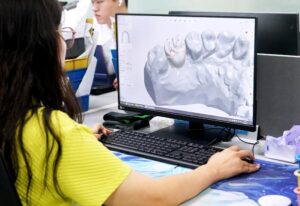
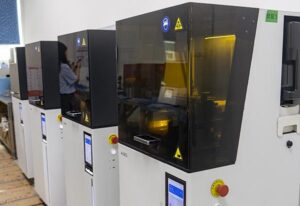
Digital bridge fabrication uses intraoral scanning for data capture, CAD software for bridge design, and CAM systems (milling or 3D printing) for production. Benefits include:
- Faster turnaround time
- Consistent quality and reproducibility
- Digital design records for future reference
- Direct communication between clinic and laboratory
- Ability to 3D-print provisional bridges from the final design
Lab Partnership Considerations
For bridge fabrication, the quality of the dental laboratory partnership is as important as material selection. Key factors include:
- Experience with the selected material system
- Digital workflow capabilities (CAD/CAM, 3D printing)
- Quality control processes and material certifications
- Communication protocols and turnaround times
- Ability to provide digital design previews before fabrication
Longevity and Maintenance
The average lifespan of a dental bridge ranges from 10 to 15 years, with well-maintained bridges lasting 20+ years. Factors affecting longevity include:
- Oral hygiene: Proper brushing, flossing with bridge threaders, and interdental cleaning prevent decay at abutment margins
- Regular professional maintenance: Professional cleanings and examinations detect problems early
- Occlusal management: Nightguards for bruxism patients protect the bridge from excessive forces
- Material selection: Choosing appropriate materials for the clinical situation prevents premature failure
- Pontic design: Hygienic pontic designs (modified ridge lap) facilitate cleaning under the pontic
Conclusion
Dental bridges remain a vital treatment option in restorative dentistry, offering predictable tooth replacement for patients who are not implant candidates or prefer a non-surgical approach. The key to success lies in matching the bridge design and material to the specific clinical situation—considering span length, abutment condition, occlusal forces, aesthetics, and patient factors.
With the advancement of digital workflows and material technologies, modern bridges offer better fit, aesthetics, and longevity than ever before. By combining evidence-based material selection with skilled laboratory fabrication and proper patient maintenance, dental bridges can provide decades of reliable, functional, and aesthetic service.